View in
What Beauty School Doesn’t Teach You (And Where to Learn It)
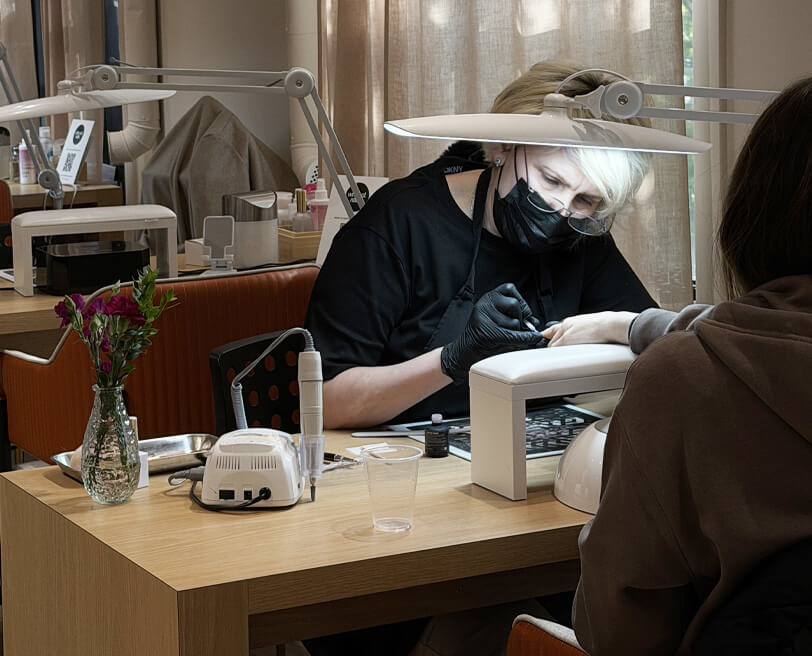
Your first week in a real salon teaches you something beauty school probably didn’t say out loud.
The license was only the beginning.
You did the hours. You studied the theory. You practiced the required services. You passed the exams. You invested time, money, energy, and probably a few stressed-out evenings wondering if you were ready.
Then you sit behind the table with a real client, in a real salon, with real expectations.
Suddenly, the gap becomes obvious.
A client wants a flawless cuticle line. A three-week gel manicure. A pedicure that feels modern, clean, and elevated. A nail structure that looks beautiful from every angle and does not start lifting after a few days.
And you realize beauty school prepared you to qualify.
It did not prepare you to stand out.
So what beauty school doesn’t teach nail technicians, where do you learn it, and how do you move beyond the basics without feeling like you are starting over?
Beauty school has a very specific job.
It teaches the foundation. It prepares you to meet the minimum professional requirements, understand basic safety, follow sanitation rules, and complete standard services correctly enough to enter the industry.
That matters.
A license protects the public. It proves you understand the basics of working safely around clients, tools, products, and sanitation procedures. That foundation is necessary.
But it is still a foundation.
Traditional nail programs usually focus on basic manicure, basic pedicure, classic polish application, infection control, salon theory, and the practical skills required to begin working legally. The training is broad because it has to be. Schools need to cover the required material, prepare students for exams, and move many different beginners through the same system.
That is not a criticism.
It is just the design.
Getting your nail license is like getting your driver’s license. It means you are legally allowed on the road. It does not mean you know how to handle traffic in New York City, parallel park under pressure, or drive confidently in every situation.
The license gets you in the chair.
Advanced training teaches you what to do once you are there.
The nail industry has moved fast.
Clients have changed. Salon standards have changed. Social media has changed what people expect from a manicure before they even book the appointment.
A standard manicure is no longer enough for many clients, especially in higher-end salons. They want cleaner results, longer wear, better structure, and a level of detail that basic school training rarely has time to cover.
That is where advanced nail techniques come in.
An e-file manicure uses an electric file for detailed cuticle prep and nail surface work. In skilled hands, it creates a cleaner, more precise result than basic manual prep alone.
This technique matters because clients notice the finish.
They may not know what tool you used. They may not know the word “e-file.” But they know when the cuticle area looks sharp, smooth, and polished. They know when gel sits cleanly near the base of the nail. They know when the manicure still looks fresh a week later.
Beauty school usually teaches basic cuticle pushing, nipping, filing, and hand-tool work. Those skills still matter, but they do not fully prepare you for the speed and precision expected in many advanced salons.
E-file manicure training is where many nail techs begin to feel the difference between “I can do a manicure” and “I can create a manicure that looks premium.”
The tool itself is not magic.
The technique is.
A combo manicure blends different prep methods to create a cleaner, more finished result around the cuticle area. It may include elements of dry technique, careful cuticle work, and detailed surface prep.
The goal is not to make the service sound fancy.
The goal is control.
A combo manicure gives the tech more precision. It helps create that crisp, almost seamless look clients save in their camera roll before an appointment. Once clients experience that kind of finish, many do not want to go back to a basic manicure.
Beauty school usually teaches one standardized manicure procedure. That makes sense for beginners, but real salon work is rarely one-size-fits-all.
Clients have different cuticles. Different nail plates. Different sensitivity. Different expectations.
Combo manicure training teaches you how to adapt your technique instead of repeating the same basic process on every hand.
That is where the work starts to look professional in a different way.
A smart pedicure is not just “a pedicure with better products.”
It is a more modern, technique-driven approach to foot care. It focuses on precision, cleanliness, comfort, and a service experience that feels more elevated than the classic soak-and-polish routine.
This matters because pedicure clients are loyal when the service feels noticeably better.
They remember comfort. They remember cleanliness. They remember the smoothness of the result. They remember when the appointment feels careful instead of rushed.
Beauty school usually covers basic pedicure steps, sanitation, polish application, and standard service flow. Again, that foundation is necessary. But it does not always teach the kind of advanced approach that turns a pedicure into a premium service clients rebook without thinking twice.
A smart pedicure helps a nail tech move beyond “I can perform the service” into “I can deliver an experience clients can feel.”
That difference affects client trust.
It also affects pricing.
Nail architecture is where many techs have their biggest “why didn’t anyone explain this sooner?” moment.
It is the structural understanding behind beautiful nails: apex, balance, stress points, shape, thickness, length, and how the product supports the natural nail.
This is the difference between nails that look good in a photo and nails that survive real life.
A client types. Cleans. Opens cans. Carries bags. Washes dishes. Taps her nails on every hard surface known to humanity. Pretty nails are not enough. They need structure.
Beauty school may introduce basic acrylic or gel application, but it often focuses on the practical exam version of the service. That does not always translate into advanced salon work.
Nail architecture teaches you why nails lift, crack, break, look bulky, or feel unbalanced. It gives you the logic behind the beauty.
Once you understand structure, your work changes.
You stop guessing.
A lot of licensed nail techs quietly blame themselves for feeling underprepared.
They think, “Maybe I should already know this.”
No. Not necessarily.
Being licensed and still feeling like something is missing is common. It does not mean you failed in school. It means school gave you the beginning, and now the industry is asking for more.
Traditional programs are built around minimum required training. Advanced technique takes time. It takes specialized instructors. It takes focused practice. It takes correction from someone who can look at your work and say, “Here is exactly why that line looks heavy,” or “Here is why this nail will not last three weeks.”
Most licensing programs cannot go that deep.
They are not designed to turn every student into an advanced salon specialist. They are designed to teach the foundation needed to begin.
The real shock happens when a new tech sits with actual clients and realizes the salon standard is higher than the school standard.
That moment can feel uncomfortable.
It is also fixable.
You do not need to start over. You need the next layer.
Advanced training usually happens outside traditional beauty school.
It happens in specialized studios, academies, and hands-on programs created for licensed nail techs who already understand the basics and want to go further.
That is where the real craft begins to sharpen.
A strong advanced program should not feel like a product demo with a certificate at the end. It should give you hands-on practice, clear correction, small enough classes for real attention, and instructors who actively understand salon-level work.
Look for training that focuses on technique, not hype.
You want to learn how to hold the tool, how to read the nail, how to correct the shape, how to control the product, how to improve your finish, and how to create results that hold up after the client leaves.
Good nail tech continuing education should help you answer questions like:
That is the kind of education Why Not Nails Academy focuses on.
WNN is an independent advanced studio and training academy for licensed nail technicians who want to go beyond nail school. The training focuses on techniques like e-file manicure, combo manicure, smart pedicure, and nail architecture – the exact skills many techs wish they had learned earlier.
It is not a licensing program.
It is the next step after licensing, for nail techs who want their work to feel more precise, more elevated, and more aligned with what today’s clients actually expect.
There is a point in every nail tech’s career where talent is not enough.
You need better systems.
Better technique.
Better correction.
Better understanding of why the result looks the way it looks.
That is where advanced education becomes career-changing. Not because a certificate magically makes you better, but because the right training changes how you see your own work.
You start noticing details you used to miss.
The cuticle line. The product thickness. The sidewall shape. The apex placement. The client’s natural nail condition. The way small technical choices affect the final result.
That awareness is what separates basic service from premium craft.
Clients feel it, too.
They may not be able to explain nail architecture. They may not know what makes an e-file manicure different. They may not understand why a smart pedicure feels cleaner and more refined.
But they know when the service feels better.
They know when the nails last.
They know when your work looks expensive.
And they come back for that.
Your license got you in the door.
That is worth respecting.
You worked for it. You earned it. You did what was required to begin your career.
But if you have been sitting behind the table feeling like something is missing from your toolkit, you are probably right. And it is not because you did not work hard enough in school.
Beauty school teaches the foundation. Advanced training builds the career.
The techniques that create cleaner manicures, stronger nails, better pedicures, and more premium client experiences usually live beyond nail school. They are learned through focused practice, expert correction, and education designed for working nail techs who want more.
If you are ready to move beyond the basics, explore Why Not Nails Academy’s advanced training programs and take the next step toward the kind of work clients remember, rebook, and recommend.