Short version: yes, a beginner can learn Russian manicure — but “can” and “should start there tomorrow” are two different questions, and the honest answer is more useful than a simple yes.
We get asked this constantly by people brand new to nails: “Do I need years of experience first, or can I go straight to Russian manicure?” The fear underneath it is usually one of two things — either “I’ll be terrible because I’ve never held an e-file,” or the opposite, “everyone online makes it look easy, so how hard can it be?” Both are worth unpacking, because the truth sits in between.
But here’s the idea we want you to hold onto through this whole article, because it flips the usual assumption: the biggest advantage a beginner has is that they don’t have bad habits yet. Experienced techs often spend part of a Russian manicure course unlearning things they’ve relied on for years — a pressure reflex, a hand position, a shortcut that works for basic gel but not for precision work. A beginner may know less, but there’s far less to correct. That’s not a small thing. It’s often the difference between learning clean technique and fighting your own muscle memory.
Yes — but treat it as a technical skill, not a beauty trend
Here’s the reframe that changes everything for a new student. Most people picture the Russian manicure as a look — that flawless, flush-to-the-skin finish they’ve seen on video. So they assume learning it means learning to recreate a look.
It doesn’t. What you’re actually learning is control of a tool near living skin. The look is just what happens when the control is good. Once you see it that way, the beginner question answers itself: you’re not too inexperienced to learn a look, but you are starting from zero on the skill that matters — reading pressure, angle, and speed while working a millimeter from tissue you must not touch. That’s learnable from day one. It just has to be taught as what it is: a precise, physical, safety-critical technique.
So the real question isn’t “am I allowed to learn this as a beginner?” It’s “am I going to learn it properly, or am I going to build fast, sloppy habits I’ll have to unlearn later?”
What a beginner actually has to build (it’s not the steps)
Most beginners expect the first challenge to be remembering the order of the steps. It almost never is. The steps are easy — you could write them on an index card in five minutes. What you can’t write on a card is everything that lives between the steps: the physical judgment that no list can hand you, only your hands can earn.
So while the sequence takes an afternoon to memorize, this is what you’re really building from the very first session:
- Hand stability — how to hold and support the client’s hand so neither of you is moving unpredictably
- Pressure control — the single biggest thing, and the one beginners get most wrong: letting the bit glide instead of pressing it in
- Speed-and-heat awareness — understanding that heat comes from friction, not from the speed dial, so you don’t burn a client by going “slow and safe”
- Reading the tissue — telling dead, safe-to-clear cuticle from the living eponychium you must leave alone
- Nail-plate prep — getting a surface clean enough that product actually bonds
- Sanitation as a workflow — sterilization isn’t a final step, it’s woven through the whole service
Notice that only one of those is about “the Russian manicure” specifically. The rest is foundational nail skill. Which leads to the question we’re really here to answer.
Should you start with Russian manicure, or learn a base manicure first?
This is where we’ll be straight with you, even though we teach both.
There’s no law that says you must do a basic manicure course before a Russian one. Plenty of people learn Russian technique as their entry point and do fine — if the training is built for beginners and spends real time on fundamentals before precision work.
But be honest with yourself about which kind of beginner you are:
If you’ve never held an e-file, never shaped a nail, never worked on a live hand — you’ll get more out of Russian training if some foundation comes first or is built into the course. Here’s why, and it’s the flip side of the “no bad habits” advantage: a total beginner is trying to learn three or four distinct skills at the same time — hand stability, bit control, tissue-reading, and millimeter-precision placement. That’s a lot to coordinate at once, and precision is the first thing to suffer when the basics aren’t yet automatic. Beginners don’t struggle because they’re beginners; they struggle when they try to learn several skills simultaneously with nothing yet on autopilot. Starting with a solid manicure course — or a program that folds those basics in — is really about making one or two of those skills automatic so you can give the precision your full attention.
If you already have some comfort on the nail — even hobby-level — you can reasonably start with a beginner-oriented Russian course and build from there.
Either way, the thing that determines your outcome isn’t the order. It’s whether someone is watching your hands and correcting you in real time.
Why theory alone genuinely doesn’t work here
You can read every word ever written about the Russian manicure and still position the e-file at the wrong angle on your first real hand. This technique is visual and physical. A small change in angle, pressure, or direction changes the entire result — and a beginner literally cannot yet see what they’re doing wrong, because they don’t know what “right” looks and feels like.
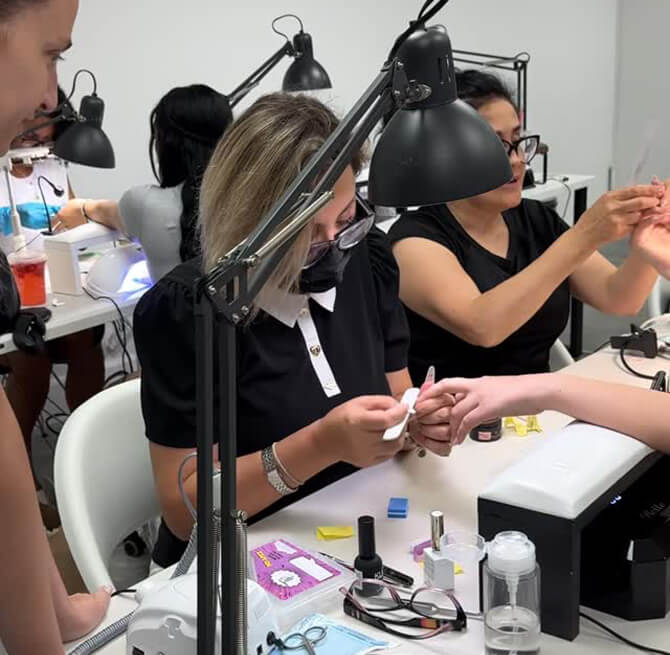
That’s the whole case for hands-on correction. A good instructor isn’t just demonstrating a movement; they’re watching yours, catching the pressed thumb or the drifting angle, and — this is the important part — explaining why it matters so the correction sticks. Immediate feedback, before a shaky movement repeats into a habit, is worth more to a beginner than any amount of extra information. Beginners don’t need more information. They need more correction.
The one thing beginners actually do better
Here’s what surprises people who assume experience is everything: in a Russian manicure course, beginners often have a real edge in a few specific ways — and it all comes back to that “no bad habits yet” idea.
They take correction more easily. When an instructor says “stop, lighten your pressure, try that again,” a beginner just… does it. There’s no reflex arguing back, no fifteen years of muscle memory pulling their hand into the old position. An experienced tech, even a great one, sometimes has to consciously override a habit that’s become invisible to them.
They don’t have to unlearn anything. Every correct movement a beginner learns goes onto a clean slate. They’re not overwriting a shortcut; they’re just building the right thing the first time.
And so they often form clean technique faster than you’d expect — sometimes faster than a mid-career tech who’s fighting ingrained habits. Less experience genuinely can mean less to undo.
None of this means beginners have it easy. It means the disadvantage is smaller than they fear, and it comes with an advantage nobody tells them about. If you’re new and nervous, that’s the part to hold onto.
What to look for before you pick a beginner course
Most schools will tell you they have experienced instructors, professional tools, and a certificate. That’s not what separates a great beginner course from an average one. These questions do. Ask them out loud before you pay:
“How much of the course is spent with an instructor correcting my hands, versus demonstrating theirs?” This is the big one. Watching a master work is inspiring and teaches you almost nothing about your own pressure. You improve when someone is correcting you. If the honest answer is “mostly demonstration,” keep looking.
“How many hours will I actually spend working on real, live hands?” Practice tips don’t sweat, don’t flinch, don’t have irritated skin or an awkward nail shape. Real hands are the entire skill. Ask for the number, not a reassurance.
“Will you teach me anatomy and sanitation as core material, or mention them in passing?” For a service that works this close to living skin, “where the safe line is” and “how tools get truly sterile” aren’t footnotes. If they’re treated as footnotes, that tells you something.
“What will I honestly be able to do the day after this course — and what will still take months of practice?” A trustworthy school gives you a straight answer here. A worried one gives you a promise.
“Exactly what does the certificate say, and what does it not mean legally?” You should know precisely what you’re earning and how it fits your state’s rules.
And the red flag that overrides all of it: be skeptical of any program promising instant mastery, guaranteed income, or that waves away the legal side. Russian manicure improves with guided practice and repetition — anyone selling it as overnight expertise is selling you the look, not the skill. (If you’re weighing your very first course, we wrote a fuller guide on how to choose the right nail course as a beginner).
The honest bottom line
A complete beginner absolutely can learn Russian manicure. The method isn’t gatekept behind years of experience — it’s gatekept behind proper technique, and proper technique is exactly what good training gives you from the start.
So don’t ask whether you’re experienced enough. Ask whether you’re going to learn it in a way that builds clean habits from the first day — because here’s the thing worth remembering: an experienced tech has to unlearn before they can improve. You just have to learn. That head start disappears the moment you build a bad habit nobody corrects, and it compounds every time someone catches one early. The whole game, for a beginner, is protecting that clean slate.
That’s what structured training is really for — someone watching your hands from day one so the first version of every movement is the right one. If you want to see how we build that foundation, our Russian Manicure Course is grounded in hands-on correction and anatomy from the start, and if you’re wondering how much you can realistically absorb quickly, we answered that honestly in is one day enough to learn Russian manicure.
Start where you are. Just start it right.