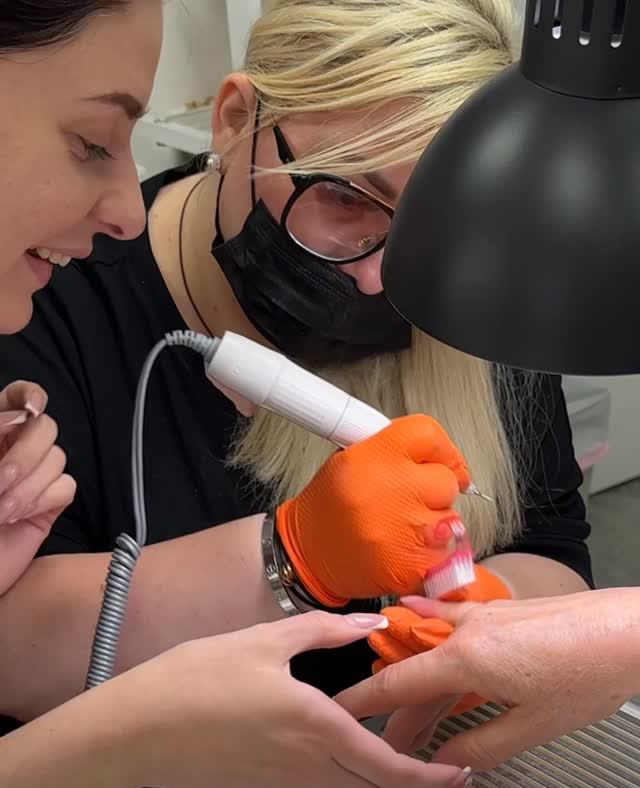
There is a very specific moment a lot of left-handed students have during their first e-file class.
The instructor picks up the handpiece with the right hand. Everything looks smooth. The angle makes sense. The movement looks easy enough to copy.
Then you pick up yours with the left hand.
Suddenly, your wrist is sitting differently, the bit seems to be moving the wrong way, and you are mentally flipping every movement before you even make it.
A left handed nail tech can easily look around the room and think, Okay, maybe this course was built for everyone except me.
It wasn’t.
Left-handed students can learn Russian Manicure technique perfectly well. The setup just needs to make sense for the hand actually holding the e-file. Rotation, bit direction, finger positioning, and your working angle may need to be adjusted. Once those pieces click, the whole thing becomes much less mysterious.
Why Rotation Direction Matters More Than Hand Dominance
Forward and reverse can be confusing at first because students sometimes hear them explained as if one setting belongs to right-handed techs and the other belongs to left-handed techs.
That is too simplistic.
Professional e-files commonly have both forward and reverse rotation specifically so the tool can be used comfortably by right- and left-handed technicians.
Your working direction still depends on what you are doing.
The side of the nail, the bit, the movement you are making, and the way you are holding the client’s finger all affect which direction feels controlled. You may use more than one rotation setting during a service.
That is the part students need to understand with e-file forward reverse rotation. Memorizing “left hand equals reverse” does not teach you much. You need to understand what the bit is doing against the surface.
When the direction and hand movement work together, the e-file feels controlled. When they do not, beginners often compensate without realizing it. The grip gets tighter. Pressure increases. The wrist starts bending into a strange angle.
Usually, that is not a sign that you are bad at using the machine.
Something in the setup probably needs correcting.
Our Russian Manicure Course includes hands-on e-file work with real models, which gives instructors a chance to catch those little things while you are actually working. The course covers e-file control, safety, cuticle technique, nail preparation, and shaping.
Bit Choice and Hand Positioning for Left-Handed Students
You do not need to throw out every bit in your kit because you use your left hand.
Plenty of bits are designed to work in either rotation direction. Some carbide bits, however, have directional cutting edges, and manufacturers do make versions specifically for left-handed technicians. STALEKS, for example, sells left-handed carbide bits with cutting edges designed for reverse rotation.
So check the bit. Do not assume.
For most students learning russian manicure for left handed technique, hand positioning becomes the bigger adjustment anyway.
Your setup may look slightly different:
- You may sit a little farther to one side.
- The client’s finger may need to turn toward you differently.
- Your machine may feel better placed on the opposite side of the table.
- Your elbow may need more room.
- The angle that gives you a clear view may not look identical to the instructor’s.
That is completely normal.
Trying to recreate a right-handed instructor’s hand position exactly can actually make things harder. Your goal is not to produce a mirror-image pose for Instagram. You need stability, visibility, and control.
A small change in how you hold the client’s finger can fix an angle that felt impossible thirty seconds earlier.
That is why hands-on correction helps so much.
What a Good Instructor Should Actually Do Differently
This is where left-handed students can tell very quickly if a class is genuinely hands-on.
An instructor does not need to be left-handed to teach you. They do need to pay attention to what your hand is doing.
Sometimes the demonstration needs to be shown beside you instead of across the table. Sometimes the instructor needs to reverse the movement visually so you can see the angle clearly. In other cases, the correction is tiny: move the elbow, rotate the client’s finger, loosen the grip, change direction.
Those are easy adjustments for an instructor who is watching.
A good instructor may need to correct:
- grip pressure;
- bit angle;
- finger support;
- wrist position;
- seating position;
- e-file placement;
- rotation direction;
- the direction of your pass.
This is also why learning from short videos can get frustrating. You can replay a movement twenty times and still have no idea that your own hand is sitting five degrees too low.
The academy’s e-file training focuses on those practical details: pressure, angle, hand positioning, bit selection, control, anatomy, and knowing when to stop. If you want a deeper look at the safety side of machine work, see E-File Safety Myths: What’s Actually True.
The point is not to make a left-handed student perform the technique exactly like a right-handed one.
The result needs to be controlled and safe. Your hand can get there by a slightly different route.
From Hesitant to Confident: What Left-Handed Students Can Expect
The first few attempts may feel clumsy.
That happens to right-handed students too.
E-file work asks your hands to do several things at once: stabilize the client’s finger, control pressure, maintain the correct angle, watch the skin, follow the nail shape, and keep the bit moving appropriately.
Nobody does all of that beautifully on attempt number one.
The extra step when learning e-file as a lefty is that you may initially spend too much brainpower translating the instructor’s movement.
Then something changes.
You stop thinking, She used her right hand, so what am I supposed to flip?
You start thinking about the nail in front of you instead. Which side am I working on? Where is my support? Is the bit sitting correctly? Does this rotation give me control?
That is the point where being left-handed becomes much less interesting.
At Why Not Nails Academy, students train hands-on rather than learning the technique through demonstration alone. The current Russian Manicure program includes real-model practice, e-file control, safety, and individual technique work.
You can also read how to choose a russian manicure course if you want to know what useful e-file training should actually include before signing up.
Being left-handed does not mean you need an entirely separate version of Russian Manicure.
You need an instructor who sees what you are doing and knows how to adjust the technique around your hand.
That is a much simpler problem to solve.