View in
What Actually Happens to Your Cuticle with an E-File
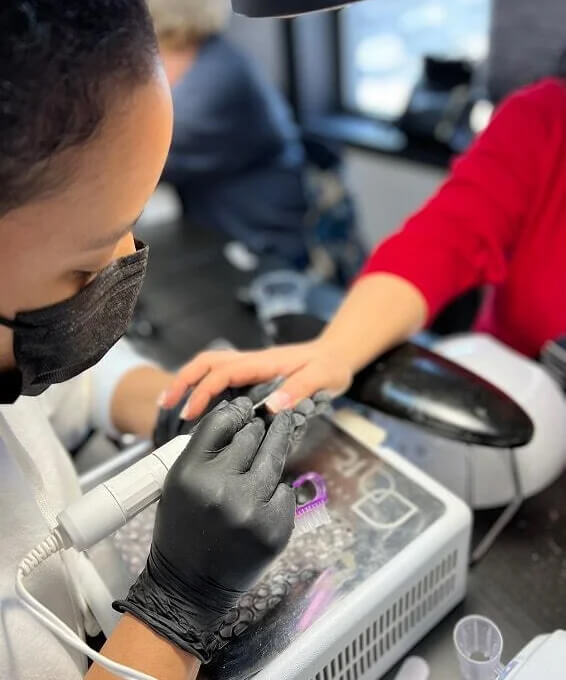
Used correctly, an e-file doesn’t cut your cuticles at all — it gently clears away only the dead tissue on the nail plate, leaving the living skin untouched. The trouble is that “cuticle” gets used to mean two very different things, and that mix-up is behind almost every worry people have about e-files.
Most clients point to all the skin around the nail and call it cuticle. Fair enough — that’s how people talk. But in nail anatomy, there’s an important difference between the cuticle and the proximal nail fold.
The cuticle is the thin, dead tissue that sticks to the nail plate. It grows out from under the skin and can make polish or gel lift if it is not removed properly.
The proximal nail fold is the living skin at the base of the nail.
Big difference.
One can be gently cleaned. The other needs to be protected.
Under that area sits the nail matrix, where new nail cells are formed. Damage there can affect how the nail grows. So when nail technicians work near the cuticle area, precision matters. This is not a place for guessing.
An e-file does not “cut off cuticles.”
At least, it should not.
When used correctly, an e-file gently exfoliates non-living tissue from the nail plate and around the cuticle area. It can remove dry skin, stuck cuticle, and pterygium more precisely than some traditional tools.
That is the point.
Precision.
A trained nail technician uses specific bits, controlled speed, light pressure, and the correct angle. The goal is to clean the nail plate without touching living tissue or thinning the skin barrier.
The e-file is not doing the thinking. The technician is.
That part matters because the same tool can be safe or unsafe depending on the person holding it. Too much pressure, wrong bit, wrong speed, or bad angle can turn a useful tool into a problem very quickly.
When e-file cuticle work is done properly, the nail plate looks clean and even.
Polish applies smoother. Gel sits closer to the cuticle area without flooding the skin. The final result looks more polished, more professional, and honestly, just cleaner.
There is also a practical benefit: retention.
Gel needs a clean surface to hold well. If dead tissue stays on the nail plate, product may lift. That does not always happen immediately. Sometimes it shows up after a few days when the client notices peeling near the base of the nail.
Annoying.
Proper e-file prep helps prevent that.
Correct technique should not cause pain. It should not leave the skin red, raw, or burning. The client may feel light vibration or gentle contact, but not discomfort.
Clean result.
No damage.
That is the standard.
Bad e-file work is easy to recognize.
Redness. Heat. Soreness. Skin that looks overworked. A nail plate that feels thin or sensitive. Tiny cuts around the cuticle area. Sometimes the client does not feel much during the appointment, then later the area feels tender.
Not good.
Over-filing can weaken the skin barrier. The skin around the nail is there for a reason. If a technician keeps removing too much or works on living tissue, the area can become irritated and sensitive over time.
The nail plate can suffer too. Too much pressure or repeated filing in the same spot may thin the natural nail. Once that happens, clients may feel burning during gel curing or discomfort during future services.
And here is the frustrating part.
The client often blames the e-file.
But the tool is not the real issue.
The technique is.
E-file work near the cuticle area requires anatomy knowledge.
You need to know what is safe to remove and what should be left alone. You need to recognize the difference between dead tissue, dry skin, pterygium, and living skin. If you cannot identify the area correctly, you cannot work safely.
Then comes bit selection.
Different bits have different shapes, textures, and purposes. A bit used for product removal is not the same as a bit used for gentle cuticle cleaning. Using the wrong one can cause damage fast.
Pressure matters too.
So does angle.
So does speed.
This is why self-taught e-file work can be risky. Videos can show the movement, but they cannot correct your hand. They cannot tell you that your pressure is too strong or your angle is too flat. They cannot see when you are overworking the same area.
A real instructor can.
That correction is not a small detail. It is the difference between building skill and building bad habits.
Manual cuticle work usually uses pushers, nippers, files, and buffers. It can be safe and effective when done by a trained technician.
E-file work uses electric rotation and specialized bits for more detailed cleaning.
Which one is better?
Depends on the technician.
An e-file can be more precise, especially for removing stuck tissue from the nail plate and cleaning around sidewalls. It can also be faster once the technician is trained. That matters in professional services where time, consistency, and finish quality all count.
Manual work can feel more familiar to beginners, but it is not automatically safer. Nippers can cut living skin. Pushers can be too aggressive. Buffers can thin the nail plate if used carelessly.
So the real comparison is not tool vs tool.
It is trained technique vs careless technique.
With proper skill, both methods can be useful. Many professionals use a combination.
“E-file always damages skin.”
False.
Bad e-file technique damages skin. Proper e-file technique works only on non-living tissue and protects the surrounding area.
“It removes live tissue.”
Incorrect when done properly.
A trained technician does not use the e-file to remove living skin. The goal is to clean dead tissue and prepare the nail plate safely.
“Manual cuticle work is always safer.”
Not automatically.
Manual tools can cause cuts, irritation, and over-removal too. Safety depends on skill, hygiene, pressure, and judgment.
“E-file is only for advanced nail techs.”
Partly true.
Beginners can learn e-file techniques, but not casually. They need structured training first. This is not a tool you learn by guessing your way through a client appointment.
Professional e-file work follows a controlled process.
The technician checks the nail condition first. Then they choose the correct bit. They use the right speed for the step. They support the client’s finger properly. They work lightly, without forcing the tool.
They also stop when the tissue is clean.
That sounds obvious, but it matters. Overworking the cuticle area is one of the biggest beginner mistakes. More filing does not mean better prep. Sometimes it just means damage.
Hygiene is part of nail health too. Bits must be cleaned and disinfected correctly. Dust needs to be managed. Tools should never move from client to client without proper sanitation.
Clean technique is not only about how the nail looks.
It is about keeping the client safe.
Proper training prevents injuries.
That is the main reason.
But it also improves the quality of the service. A trained nail technician can create cleaner prep, smoother application, better retention, and a more professional finish.
Clients notice.
They may not know the anatomy terms, but they know when their nails look neat and feel comfortable. They know when gel lasts longer. They know when the service feels careful instead of rough.
That builds reputation.
And reputation affects pricing. Nail techs who can offer safe, detailed, high-quality services can usually position their work at a higher level.
If your goal is to become confident with e-file work and other professional techniques, structured education matters. A full nail technician program can help students build those skills step by step instead of trying to learn advanced work out of order.
E-file learning should be guided.
First, anatomy. Then hygiene. Then tool handling. Then basic movements. Then model practice. Then correction.
Not all at once.
A good training path lets students build confidence without rushing them into risky work. You learn how to hold the hand, how to stabilize your own movement, how to choose bits, how to control pressure, and how to read the nail in front of you.
Practice on models is important because real nails are not identical. Some clients have thin nail plates. Some have dry cuticles. Some have sensitive skin. Some have product left from previous services.
That is real life.
Supervised training helps beginners learn what to do when the nail in front of them does not look like the demo.
Because it often will not.
An e-file is not dangerous by itself.
It is a tool.
Used correctly, it helps clean the cuticle area, improve product application, and create a more professional finish. Used incorrectly, it can irritate skin, thin the nail plate, and damage client trust.
So the answer is simple: technique determines the outcome.
Professional education gives nail technicians the anatomy knowledge, safety habits, and hands-on correction they need to use an e-file properly. For beginners, that structure is not extra. It is the foundation.
Learn it right first.
Fixing bad habits later is harder.
Not when used correctly. An e-file should only remove non-living tissue around the cuticle area. Damage happens when the technician uses the wrong bit, speed, pressure, or angle.
It depends on the technician’s skill level. E-file work can be more precise and efficient, but manual tools can also be safe when used correctly. Training matters more than the tool itself.
Yes, but only after structured professional training. Beginners need to understand nail anatomy, bit selection, pressure control, hygiene, and safe technique before using an e-file on clients.
Only non-living tissue and pterygium are safe to remove when properly identified. Living skin, including the proximal nail fold, should be protected, not filed away.