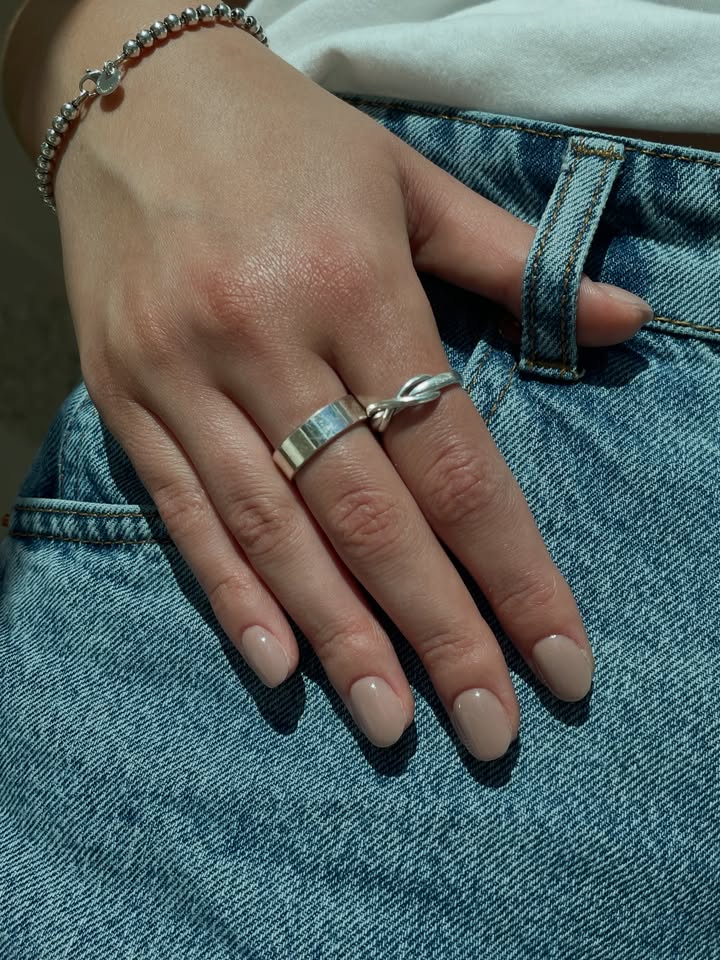
If you bite your nails, you probably know how stupidly easy it is to ruin three weeks of progress in about thirty seconds.
One nail catches on your sweater. You feel a rough corner. There is a tiny piece of skin near the cuticle that suddenly becomes impossible to ignore.
You pick at it a little.
Then more.
And, well. There goes the nail.
That is why a russian manicure for nail biters can actually be useful. Not because a manicure somehow switches the habit off. It doesn’t. But it can remove a lot of the physical stuff you keep noticing and messing with in the first place.
Rough skin. Snags. Uneven edges. Little broken corners.
And if your nails are very short and flimsy, hard gel can give them enough structure to finally grow a bit without immediately bending, splitting, or disappearing again.
Honestly, at the beginning, that is the win.
Not long nails.
Nails that stay there.
Why Nail Biters Struggle to Grow Their Nails
People usually think the whole issue is just “stop putting your fingers in your mouth.”
Which is technically true. Also not very helpful.
Because nail biting gets very physical very quickly.
You feel a hangnail. You notice one edge is sharper than the others. A bit of skin is dry. One nail grows slightly crooked after being bitten too short.
Now there is something there.
Something to pick at.
That is why how to stop biting nails is often not just about willpower. You also need to make the nails less tempting to mess with.
There are a few things nail biters deal with all the time:
- very short free edges;
- rough skin around the nails;
- little splits and snags;
- uneven nail shapes;
- thin or bendy nails;
- the habit of “fixing” anything that feels off.
And once you have been doing it for years, you notice every tiny imperfection.
People who do not bite their nails can just ignore a rough corner.
Nail biters often cannot.
Smooth Cuticle Work Can Help More Than You’d Think
This is the part that seems minor until you actually have it done properly.
Russian Manicure work is very detailed around the cuticle area. The dry e-file technique lets the technician clean up nonliving tissue around the nail and refine the area much more closely than a quick basic manicure usually does.
And that smoothness matters when you are someone who picks.
No random edge.
No little dry bit sticking up.
No “I’ll just bite this one piece off” situation.
There is one technical thing worth clearing up because this gets said incorrectly in nail content all the time.
People often call the thin tissue stuck to the nail plate “pterygium.” Medically, that word actually refers to something else. In this context, we are talking about nonliving tissue attached to the nail plate around the cuticle area.
It can be removed carefully during prep. Carefully is doing a lot of work in that sentence.
A good Russian manicure is not supposed to hurt, and the goal is definitely not to cut away every bit of skin around the nail because “cleaner is better.”
If the skin is already cracked, bleeding, or really sore from biting, say that before the service starts. Sometimes the right thing is to leave a spot alone.
Hard Gel Helps With the Annoying In-Between Stage
This is where people usually get impatient.
The cuticle area looks clean. The nails look much better already.
Now you want length.
Immediately.
That is usually not the best idea.
Very short bitten nails often need some time before they are ready for much length. They may be thin. They can bend easily. Sometimes there is barely any free edge at all.
Hard gel can help because it adds structure over the natural nail.
Not a giant extension.
Not a dramatic shape on day one.
Just support.
Enough that the nail has a better chance of surviving normal life while it grows.
If you are trying to grow nails after biting, the first few appointments can be pretty boring, visually.
That is okay.
A realistic process often looks like this:
- Get the skin and cuticle area cleaned up.
- Keep the nails short and comfortable.
- Add reinforcement if the natural nail needs it.
- Come back before lifting or breakage gets bad.
- Let the length build slowly.
The temptation is to go long the second you see a little growth.
Try not to.
A short nail that stays intact for three weeks is doing more for you than a long one that snaps after four days.
Why This Can Make the Habit Easier to Manage
A lot of nail biting happens while your brain is busy doing something else.
Emails.
Netflix.
Traffic.
Studying.
You are not necessarily sitting there thinking, “I will now destroy my nails.”
You just feel something rough.
That is the trigger.
This is one reason a nail biting solution manicure can genuinely help some people. The surface feels smoother. The edges are cleaner. Hard gel also changes the feel of the nail enough that you notice it before you bite down.
Sometimes that little moment of awareness is useful.
You catch yourself.
You stop.
Not every time, obviously.
But more often.
That is progress.
And there is another thing people do not talk about much: once your nails finally start looking nice, you become a little more protective of them.
You spent time on them.
You paid for the service.
You can see the difference.
That can be surprisingly motivating.
What This Can and Cannot Fix
This part needs to be very clear.
Russian Manicure can help remove some physical triggers.
Hard gel can help protect short nails.
Neither one cures nail biting.
If you bite when you are anxious, stressed, bored, or deep in concentration, the urge may still show up. You may also swap biting for picking at the gel if you are not careful, especially once there is lifting.
So yes, there is still some effort involved.
You still need to notice what you are doing.
You may need to keep your hands busy.
You may need bitter polish.
You may need to come in sooner than usual because once the product starts lifting, you will probably want to pick at it.
And if the biting is severe enough that the skin is swollen, infected, bleeding often, or constantly painful, a manicure is not the full answer. Get the skin healthy first.
For maintenance, every two to three weeks is a pretty sensible rhythm for many people growing out bitten nails.
Some need shorter intervals at the beginning.
That depends on how fast your nails grow, how the gel is wearing, and, frankly, how much you are messing with them between appointments. Good aftercare matters too, especially while you’re growing out bitten nails.
The progress is not dramatic at first.
Week two: still short.
Week four: maybe there is finally a little edge.
Then a couple of appointments later, you suddenly realize there is enough nail to shape properly.
That is usually how it goes.
Slow, slightly boring, and then suddenly very satisfying.