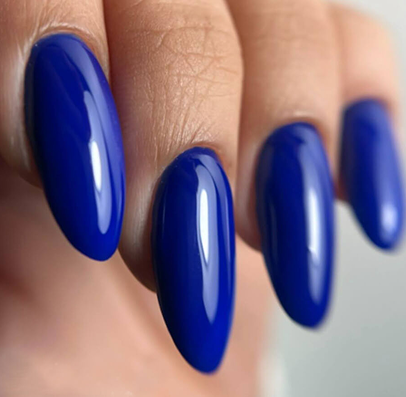
Hard gel and builder gel can look almost identical when they are sitting on a nail tech’s desk. Both can add structure. Both can reinforce natural nails. Both can create that smooth, balanced surface clients expect from a structured manicure.
Then you start working with them, and the similarities end pretty quickly.
The hard gel vs builder gel debate often gets reduced to strength: hard gel is stronger, so hard gel must be better. That skips the useful part of the conversation. A short, flexible natural nail does not need the same product behavior as a long extension on a client who uses her hands constantly.
The better question is: what does this particular nail need?
What Is Hard Gel?
So, what is hard gel exactly?
Hard gel is a UV/LED-cured gel system designed to create durable structure. It is commonly used for overlays, corrections, and extensions where the nail needs more rigid support. Depending on the product, the consistency can range from medium to quite thick, and many systems come in pots that are applied with a separate gel brush.
Hard gel generally stays where the technician places it more than a thin self-leveling builder does. That can be useful when creating an apex or correcting the architecture of a nail, though it also asks for better brush control. Too much product in the wrong place means extra filing later.
Its biggest practical distinction is removal.
Traditional hard gel is file-off only. Acetone will not dissolve it the way it dissolves a soak-off gel system. During maintenance, a technician normally files away lifted or excess product, leaves a safe layer where appropriate, and rebalances the nail.
That makes hard gel especially useful when a client plans to maintain the enhancement rather than remove it completely every few appointments.
What Is Builder Gel?
The answer to what is builder gel gets slightly more complicated because “builder gel” now describes several products.
For this comparison, we are talking about soak-off builder in a bottle, often called BIAB-style builder. These products usually come in a polish-style bottle with a built-in brush and have a thinner, more self-leveling consistency than traditional pot hard gel.
That makes the application feel familiar to techs who already work with gel polish, although building good structure still takes practice. You are controlling product movement, apex placement, sidewalls, and thickness at the free edge. Self-leveling does not mean self-correcting.
A soak-off builder can usually be removed with acetone after the surface has been properly filed to break the top layer, following the manufacturer’s instructions. Proper e-file prep matters just as much here as with hard gel — a clean, correctly filed surface determines how well any gel system performs, soak-off or not.
That removable nature is one of its biggest advantages for clients who prefer shorter enhancements, change systems frequently, or do not want to commit to a file-off product.
One important clarification: not every product sold as “builder gel” is soak-off. Some builder gels are hard-gel formulations. Always check the manufacturer’s instructions instead of relying on the word “builder” on the label.
Hard Gel vs. Builder Gel: The Main Differences
The difference between hard gel and builder gel becomes much clearer once you compare how they behave in real services.
| Hard Gel | Soak-Off Builder Gel / BIAB-Style | |
| Structure | More rigid and highly supportive | More flexible |
| Best suited to | Longer enhancements, corrections, strong overlays | Short-to-medium natural nails and overlays |
| Consistency | Usually thicker and more controllable | Usually thinner and more self-leveling |
| Application | Often requires more brush control and shaping | Faster bottle-and-brush application |
| Removal | Filed off | Can usually be soaked off |
| Maintenance | Often rebalanced rather than fully removed | Can be infilled or removed, depending on the system |
The strength question needs some nuance.
Hard gel usually gives the technician more rigid structure, which is why it is often the better choice for longer extensions. More flexibility can be useful too, though. A short natural nail that bends slightly may work better with a builder product that can move with it rather than sitting as a very rigid shell.
So in the builder gel vs hard gel conversation, “stronger” does not automatically mean “more suitable.”
How to Choose for the Client in Front of You
This is where product knowledge becomes more useful than product loyalty.
Weak or Brittle Natural Nails
For a client keeping relatively short natural nails, a soak-off builder is often a practical starting point.
It can reinforce the nail, smooth unevenness, and create a modest apex without adding the rigidity or bulk needed for a long extension. A slightly more flexible formulation may also suit nails that naturally move under pressure.
That does not mean builder gel can repair an unhealthy nail. If the nail plate is significantly damaged, painful, separating, or showing signs of disease, adding more product is not the solution.
Long Extensions and an Active Lifestyle
This is where hard gel usually makes more sense.
Long nails create greater leverage at the stress area. A client who wants substantial length and uses her hands heavily needs enough structure to support that extension.
Hard gel gives the technician more control over architecture and tends to hold longer lengths more reliably.
The nail still has to be built correctly. A strong product cannot compensate for an apex placed in the wrong area or sidewalls that have been over-filed.
Clients Who Want Easier Removal
A soak-off builder has a clear advantage here.
Some clients like changing their length, shape, or system regularly. Others move between salons and do not want another technician dealing with an unfamiliar file-off product.
A soak-off system gives more flexibility at removal time.
“Easier,” though, does not mean the product should be peeled or scraped away. Acetone removal still needs patience, and repeated aggressive removal can damage the natural nail just as easily as poor filing can.
Clients Who Keep Coming Back for Maintenance
Hard gel can work beautifully for clients who maintain their enhancements consistently.
There is usually no reason to remove the entire system every visit. The technician can reduce the existing product, correct the architecture as the nail grows, and rebuild the balance.
For the right client, that makes file-off gel very efficient over time — a structured, repeatable service like this is also where a well-designed combo manicure approach can fit naturally into a maintenance routine.
Learning Both Makes You a More Flexible Nail Tech
A technician who knows only one system eventually starts trying to make that system solve every problem.
That is where things get awkward.
A short flexible nail, a corrected downward-growing nail, and a long almond extension do not ask for exactly the same material behavior. Knowing both hard gel and bottled builder gives you more room to make the product fit the client instead of making the client fit the product.
It also improves your eye for structure. Once you understand how rigidity, flexibility, viscosity, and removal affect the service, choosing between products becomes much less confusing. If this is an area where your training left gaps, a dedicated gel nail course is usually the fastest way to close them.
The useful skill is not being loyal to hard gel or builder gel.
It is knowing why you picked one.