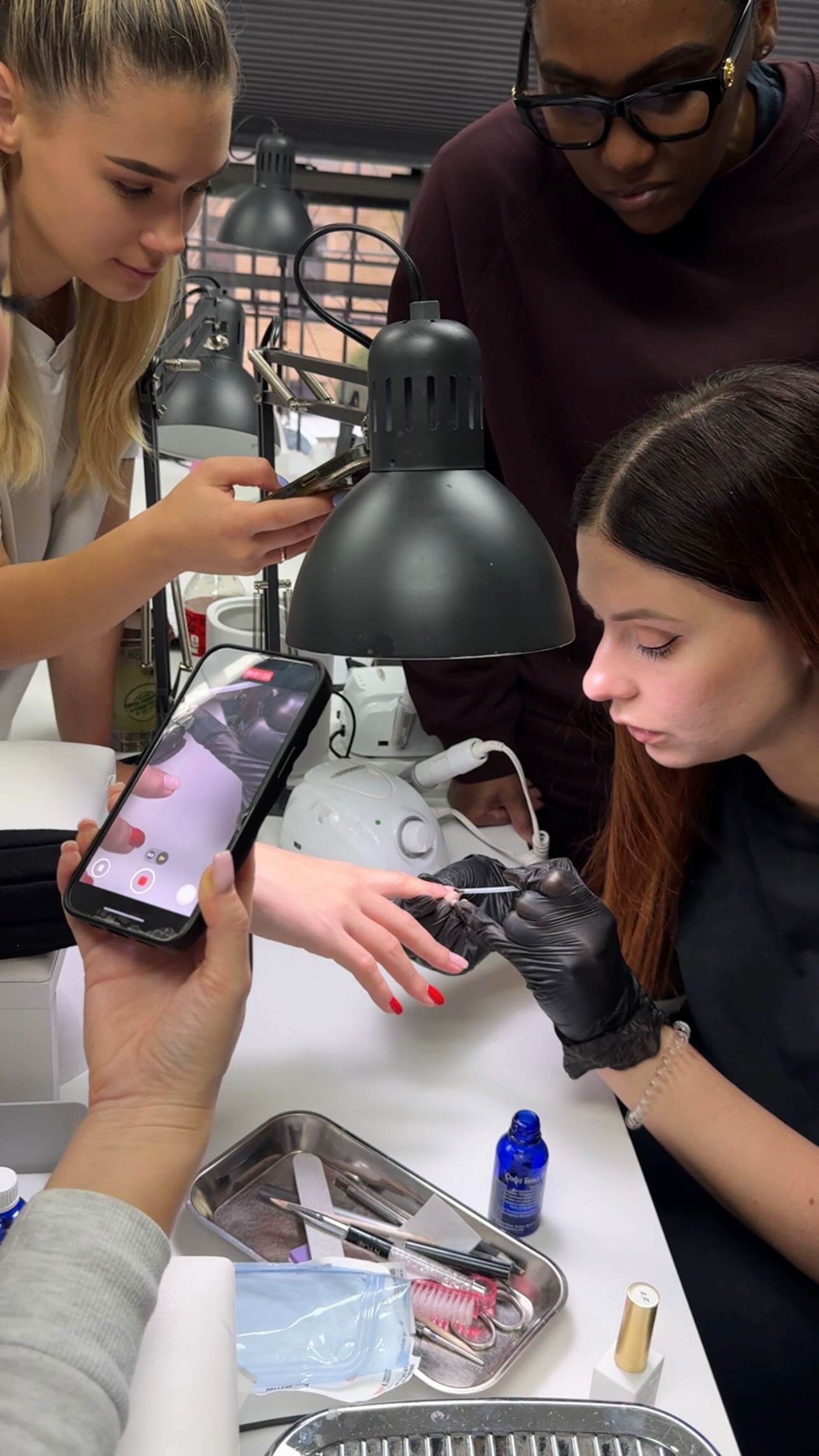
After teaching hundreds of students the Russian manicure, we’ve stopped being surprised by the mistakes. The same ones show up again and again — not because our students aren’t talented, but because these are the exact things nobody tells you until someone is standing over your hands, watching you work.
Most of them aren’t about talent or “having a steady hand.” They’re about a handful of assumptions that feel completely reasonable until they’re quietly ruining your results. So here’s what we find ourselves explaining in almost every class — the things we genuinely wish every tech knew before they picked up an e-file for their first Russian manicure.
Mistake #1: Thinking the e-file does the work
This is the big one, and almost everyone arrives believing it. The assumption is that the drill is the powerful part and your job is to point it in the right place. It’s backwards. The e-file is precise, but you are the control system — and the moment you let the tool take over, it stops gliding and starts grinding.
The tell is always pressure. New techs press the bit into the nail to make it work faster, and that pressure is what causes nearly every problem people blame on the drill: heat, over-filing, catching, that burning a client feels and doesn’t mention until it’s already too much. The bit should glide, not dig — think of a fingertip resting on a phone screen, not a pen pushed into paper. As the pros put it, if you feel the need to push harder, your speed is too low, or your bit is dull — never compensate with force.
Once a student stops fighting the tool and lets it do what it’s designed to do, half their other problems disappear at once.
Mistake #2: Believing slower always means safer
This one is so intuitive that people are shocked when we correct it. Every instinct says: nervous? turn the speed down. But heat doesn’t come from speed — it comes from friction. And friction comes from pressure and from hovering in one spot.
Here’s the counterintuitive truth we end up demonstrating in almost every class: high RPM with feather-light pressure can feel cooler than low RPM with heavy pressure, because the bit cuts cleanly instead of rubbing. What actually happens with a scared beginner is a trap: they set the RPM low to feel safe, then — because removal feels slow — they unconsciously press harder. Low speed plus heavy pressure is the single most common recipe for burning a client that we see.
The real skill isn’t “low and slow.” It’s matching speed, bit, pressure, and movement to the task in front of you. That’s learnable in an afternoon of guided practice — but almost nobody arrives at it alone.
Mistake #3: Not really knowing where living tissue begins
Everyone nods when we talk about anatomy. Then we put a real hand in front of them and ask them to point to where the dead cuticle ends and the living eponychium begins — and the confidence evaporates.
This is the difference between a beautiful Russian manicure and an infection risk, and it’s not a metaphor. The cuticle is the thin band of dead, keratinized tissue stuck to the nail plate — no blood, no nerves, safe to clear. The eponychium is the living fold of skin that produces it. The entire safety of the technique lives in one rule: the bit and scissors touch non-living tissue only. Cross into living skin and you’ve made a wound — and repeated trauma there is a documented path to chronic paronychia and to the ridges (Beau’s lines) that show up when the nail’s matrix gets injured.
The students who struggle here aren’t reckless. They just genuinely can’t yet see the boundary — and you cannot work safely along a line you can’t see. This is why we spend real hours on anatomy before anyone goes near a client’s cuticle with a drill.
Mistake #4: Copying the look instead of understanding the technique
Almost everyone learns about the Russian manicure the same way: a few seconds of video, a satisfying close-up, product sitting impossibly flush to the skin. So techs arrive trying to reproduce the image — and the image is a trap, because it teaches you to chase the wrong target.
Somewhere on social media, “Russian manicure” got equated with “get the product as close to the skin as humanly possible.” So techs work closer — and closer is exactly the wrong goal. The look you’re admiring in that clip isn’t the result of someone working aggressively close; it’s the result of someone working with control. The flush line is a byproduct of clean prep and precise placement, not the thing they were aiming at.
When we watch a student copy the look instead of understanding what produces it, the same things fall apart every time: flooded sidewalls, uneven product thickness, a cuticle line that looks perfect from straight above and messy from every other angle, and skin that’s pink and irritated by the end. They got “close,” and lost everything that actually makes the manicure good.
A clean line a hair further out — even, safe, and identical on all ten nails — beats an aggressively close line that’s flooding three of them. Understanding why each movement happens is what lets you recreate the look on any client, any nail shape, any day. Copying it only works until you meet a nail that doesn’t behave like the one in the video.
Mistake #5: Being unable to diagnose your own work
This is the quiet one, and it’s the real difference between a tech who plateaus and one who keeps getting better. Most techs can feel when a result is “off.” Far fewer can name why — was it pressure, bit angle, product amount, prep sequence, timing, hand position?
Without that diagnostic skill, you can practice for years and just get faster at repeating the same invisible mistake. And here’s a trap we untangle constantly: when a bit keeps catching or overheating, techs blame their own hands and press harder — when the real culprit is often the wrong grit, a dull bit, or an underpowered machine whose motor slows down under working pressure, creating the friction inconsistencies that cause catching. Learning to tell “my technique” from “my tool” saves people years of frustration.
What surprised us most as instructors
The students who improve the fastest aren’t always the ones with the most experience. They’re the ones who are comfortable hearing “Stop — try that again.” Technical skill grows much faster when the feedback is immediate, before a shaky movement gets repeated into a habit. Some of the most experienced techs actually progress slower at first, because they have more automatic habits to unlearn. The trait that predicts who gets great isn’t years behind the table — it’s how well someone takes real-time correction without taking it personally.
The pattern underneath all five
Notice what every one of these mistakes has in common: none of them is really about equipment. Not a new bit, not a fancier drill, not a different gel. They’re all about control — pressure, angle, speed, observation, and the anatomical knowledge to know where the safe line is.
That’s also why Russian manicure is genuinely taught as its own skill rather than picked up from a video. It’s not that the individual movements are complex. It’s that doing them cleanly, safely, and identically every single time, millimeters from living skin, is a coordination of several things at once that only clicks when someone can watch you and catch the specific habit you’ve stopped noticing.
And that’s the honest takeaway: the biggest breakthrough for most techs isn’t learning a new bit or buying a better e-file. It’s having an instructor watch your hands and point out the one movement you’ve stopped noticing — the hover, the extra half-second of pressure, the angle that drifts on the left sidewall. That’s exactly what structured Russian manicure training is designed to do. If you’d rather refine what you already have in a single focused session, the One-Day Russian Manicure Course does exactly that — and if you want to understand the tool side first, our guide to what actually happens to your cuticle with an e-file is a good place to start.
Everyone comes in making at least a couple of these mistakes. The techs who get great aren’t the ones who never made them — they’re the ones who found out which ones were theirs.